
Types of Coffee in Uganda

Picture this: you're sitting on the veranda of a luxury lodge, nestled in the shadow of Mount Elgon, with a freshly brewed cup of coffee warming your hands as the mist lifts over terraced hillsides dotted with coffee trees. The aroma is rich, complex, and unmistakably Ugandan. This is not just a morning ritual; it's an invitation to understand a nation where coffee is woven into the very fabric of daily life and economic survival.
For over a decade, Kwezi Adventures has guided discerning travelers through Uganda's most extraordinary landscapes, including the high-altitude volcanic slopes where some of Africa's finest types of coffee in Uganda are cultivated. We've walked alongside farmers in the Bugisu region, witnessed the meticulous hand-picking of ripe cherries on Mount Rwenzori, and shared countless cups with the communities whose livelihoods depend on this remarkable crop.
Uganda is Africa's largest exporter of Robusta coffee and the continent's second-largest coffee producer overall. According to the Uganda Coffee Development Authority (UCDA), coffee supports over 1.7 million households across the country, making it a cornerstone of the national economy. The country produces two primary types of coffee in Uganda: Robusta (Coffea canephora), accounting for approximately 80% of production, and Arabica (Coffea arabica), making up the remaining 20%. Our insights draw from UCDA data, direct engagement with coffee-growing communities, and firsthand knowledge of Uganda's coffee regions.
This guide combines official agricultural statistics with on-the-ground observations from our travels through Uganda's coffee heartlands. We'll provide accurate, up-to-date information on growing regions, flavor profiles, and the cultural significance of coffee, ensuring you have everything you need to appreciate this essential aspect of Ugandan life.
We'll explore the two primary types of coffee in Uganda, Robusta and Arabica, in depth, comparing their growing conditions, flavor characteristics, and economic importance. We'll introduce you to the high-altitude regions where specialty Arabica thrives, explain key classifications like Bugisu and Wugar, and share how you can experience Uganda's coffee culture firsthand on your safari.
Uganda's Coffee Story
Coffee is not merely an agricultural product in Uganda; it is a lifeline. The Uganda Coffee Development Authority reports that over 1.7 million households depend on coffee for their livelihoods. In the central, eastern, and western regions, entire communities organize their seasons around the coffee harvest. The crop generates hundreds of millions of dollars in export revenue annually and has been central to Uganda's economy for generations.
What makes Uganda's coffee story unique is its dual production. Unlike many coffee-producing nations that focus exclusively on one variety, Uganda is a rare country that cultivates both Robusta and Arabica on a significant scale. This diversity reflects the country's varied geography, from the lowland forests where Robusta originated to the volcanic highlands where Arabica flourishes.
The Two Primary Types of Coffee in Uganda
1. Robusta Coffee (Coffea canephora): Africa's Largest Exporter
Robusta coffee is Uganda's agricultural powerhouse, accounting for approximately 80% of the country's coffee production. Uganda stands as Africa's largest exporter of Robusta, a position earned through ideal growing conditions and generations of farming expertise.
Growing Regions
Robusta thrives in lower-altitude, warm areas across Uganda's central, eastern (Busoga), northern, and western regions. The tree's resilience allows cultivation at elevations between 800 and 1,500 meters, where temperatures remain consistently warm.
Key Robusta-growing areas include:
Central Uganda: The "coffee belt" surrounding Kampala
Busoga Region: Eastern Uganda's traditional Robusta heartland
Northern Uganda: Expanding production areas
Western Uganda: Lower-altitude zones suitable for Robusta
Varieties
Traditional Robusta varieties include Nganda and Erecta, which have been cultivated for generations. In recent years, the Uganda Coffee Development Authority has introduced modern, high-yielding Clonal Robusta varieties, including disease-resistant "Robusta 8, 9, and 10," which boost production while maintaining flavor quality.
Flavor Profile
Robusta coffee is known for its strong, bold, earthy, and chocolatey character. It contains nearly twice the caffeine of Arabica, contributing to its intense flavor and characteristic bitterness. The beans produce a thick, creamy crema, making them highly prized for espresso blends. The flavor notes typically include:
Dark chocolate
Earthy, woody undertones
Peanut or nutty hints
Low acidity
Full body with lingering finish
Economic Significance
Uganda's Robusta dominates export volumes, with major markets including Italy, Spain, Germany, and increasingly China and India. The bean's versatility is suitable for instant coffee, espresso blends, and specialty preparations ensures consistent global demand.
2. Arabica Coffee (Coffea arabica): Uganda's Specialty Treasure
While Robusta dominates in volume, Arabica represents Uganda's premium coffee offering. Grown in high-altitude volcanic regions, Ugandan Arabica produces beans with exceptional complexity and sweetness, increasingly recognized in specialty coffee markets worldwide.
Growing Regions
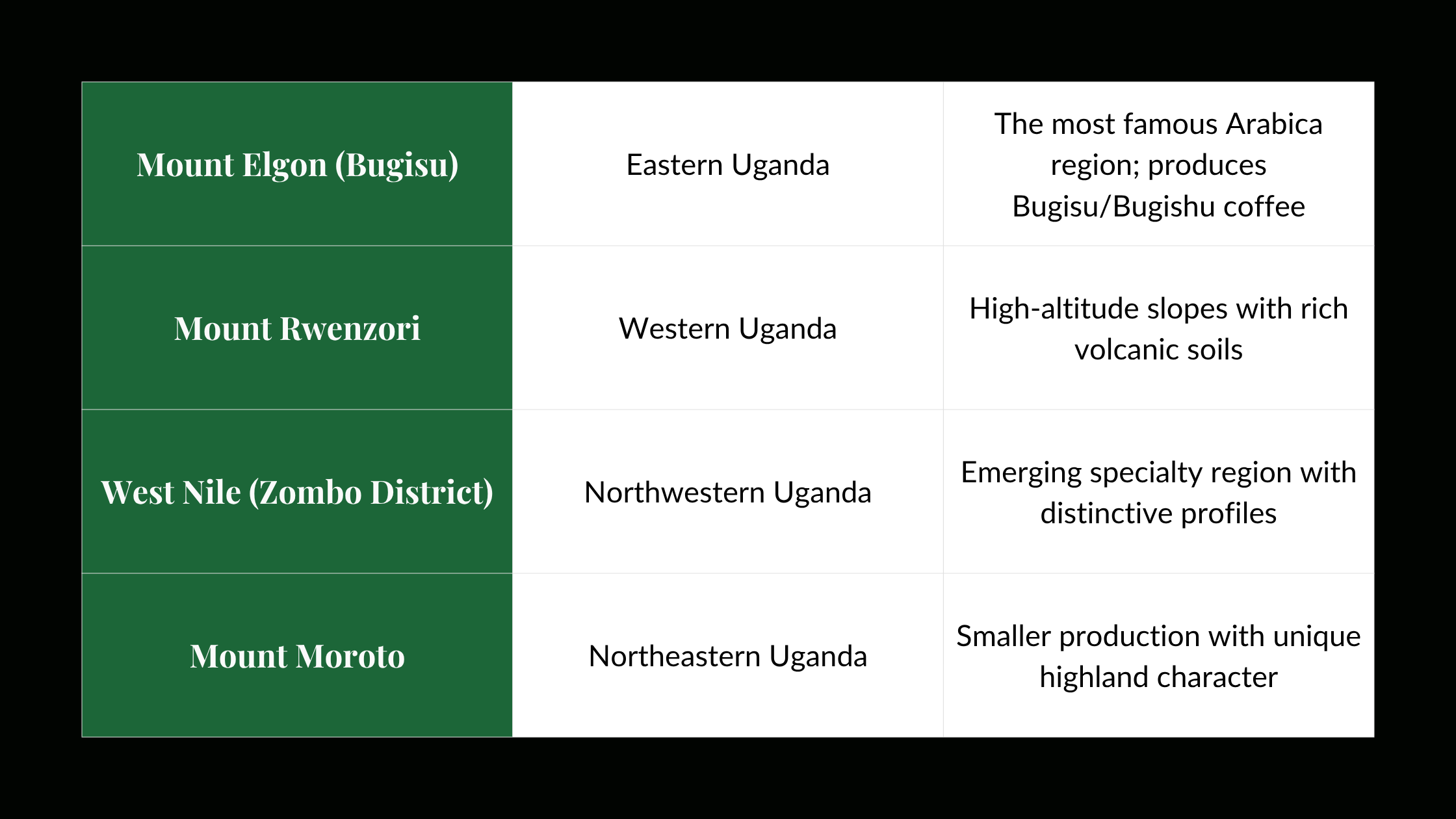
Arabica demands higher elevations, typically 1,500 to 2,500 meters above sea level, where cooler temperatures and volcanic soils create ideal conditions for developing complex flavors. Uganda's premier Arabica-growing regions include:
Varieties
Ugandan Arabica encompasses several distinguished varieties:
SL14 & SL28: Classic varieties introduced from Kenya, prized for disease resistance and flavor
Blue Mountain: Jamaican-origin variety adapted to Ugandan highlands
Kent: Traditional variety known for balanced cup profile
Nyasaland: Oldest Arabica variety in Uganda, cultivated for generations
Flavor Profile
High-altitude Arabica produces a sweeter, vibrant, and fruitier flavor profile than its Robusta counterpart. The beans develop slowly in cool mountain conditions, allowing complex sugars to form. Typical flavor notes include:
Bright berry and stone fruit
Citrus brightness
Floral undertones (jasmine, orange blossom)
Chocolate and caramel sweetness
Balanced acidity
Clean, elegant finish
Processing Methods: Wugar and Drugar
Ugandan Arabica is classified by processing method:
Wugar (Washed Uganda Arabica): The beans are depulped and fermented in water, producing a cleaner, brighter cup with pronounced acidity and fruit notes. This method dominates specialty production.
Drugar (Dry Uganda Arabica): The beans dry with the fruit intact, resulting in a heavier body, deeper sweetness, and wine-like complexity.
Key Coffee Classifications You Should Know
Bugisu/Bugishu: Uganda's Premier Arabica
The most celebrated type of coffee in Uganda for specialty drinkers is Bugisu (or Bugishu), grown on the slopes of Mount Elgon in eastern Uganda. This high-altitude Arabica is known for its balanced cup profile, featuring bright acidity, berry notes, and chocolate undertones. Bugisu coffee has earned recognition in international competitions and represents Uganda's finest offering to the specialty coffee market.
New Clonal Varieties: Innovation for Sustainability
To boost production while maintaining quality, the Uganda Coffee Development Authority has developed disease-resistant Clonal Robusta varieties Robusta 8, 9, and 10. These high-yielding plants produce consistently high-quality beans, enabling farmers to increase income while reducing disease risk. The program exemplifies Uganda's commitment to sustainable coffee production.
Comparing Robusta and Arabica: A Side-by-Side Guide

Coffee and Culture: Experiencing Uganda's Coffee Heritage
For travelers on a luxury Uganda safari, engaging with coffee culture offers an authentic connection to rural life. Many lodges and tour operators now offer coffee experiences that go far beyond a simple tasting.
Coffee Farm Visits
In the Bugisu region, guided tours of Arabica farms allow visitors to walk among coffee trees, learn about cultivation practices, and participate in the harvest during the season (typically October–February for Arabica). Farmers share stories passed down through generations, explaining how coffee has shaped family histories and community development.
Processing Demonstrations
Visitors can witness the transformation of cherry to bean from hand-picking to washing, drying, and sorting. In areas producing Wugar and Drugar coffee, you'll see the distinct processing methods and understand how they influence final flavor profiles.
Cupping Sessions
Increasingly, lodges near coffee regions offer professional cupping sessions, where guests taste multiple types of coffee in Uganda side by side, learning to identify flavor notes and appreciate quality distinctions. These sessions often highlight the difference between high-altitude Arabica and lowland Robusta, demonstrating Uganda's remarkable diversity.
Community Engagement
Perhaps most meaningful are the conversations with coffee-farming families. Over 1.7 million households depend on coffee, and many welcome visitors into their homes, sharing not just coffee but the stories of resilience, hope, and pride that define Uganda's coffee communities.
People Also Ask About Types of Coffee in Uganda
Q: What is the difference between Robusta and Arabica coffee?
A: The two types of coffee in Uganda differ significantly. Robusta (80% of production) grows at lower altitudes, has higher caffeine, and offers a bold, earthy, chocolatey flavor. Arabica (20%) thrives in high-altitude volcanic regions like Mount Elgon, has lower caffeine, and produces sweeter, fruitier, more complex flavor profiles. Robusta is primarily used in espresso blends and instant coffee, while Arabica is prized for specialty, single-origin offerings.
Q: Which region in Uganda produces the best Arabica coffee?
A:Bugisu coffee, grown on the slopes of Mount Elgon, is Uganda's most celebrated Arabica. The high altitude (1,500–2,500m), volcanic soils, and traditional cultivation methods produce beans with bright acidity, berry notes, and chocolate undertones that have earned international recognition. Other premium Arabica regions include Mount Rwenzori and the West Nile's Zombo district.
Q: What is Bugisu coffee?
A: Bugisu (also spelled Bugishu) is Uganda's premier type of coffee in Uganda, a high-altitude Arabica grown on Mount Elgon in the eastern region. It is known for its balanced cup profile, bright acidity, berry and stone fruit notes, and chocolate finish, and is the country's most recognized specialty coffee.
Q: How important is coffee to Uganda's economy?
A: Coffee is crucial to Uganda, supporting over 1.7 million households. The country is Africa's largest exporter of Robusta and the continent's second-largest coffee producer overall. Coffee generates hundreds of millions in export revenue annually and serves as a primary cash crop for families across central, eastern, and western regions.
Q: What are Wugar and Drugar coffee?
A: These are classifications of Ugandan Arabica based on processing method. Wugar (Washed Uganda Arabica) involves depulping and fermenting beans in water, producing a cleaner, brighter cup. Drugar (Dry Uganda Arabica) involves drying beans with the fruit intact, resulting in a heavier body, deeper sweetness, and wine-like complexity. Both are cultivated primarily along the Democratic Republic of Congo border region.
Q: What new coffee varieties are being developed in Uganda?
A: The Uganda Coffee Development Authority has developed disease-resistant Clonal Robusta varieties Robusta 8, 9, and 10 that increase yields while maintaining flavor quality. These modern varieties help farmers improve productivity and resilience against disease.
Q: Where can I experience coffee culture on my Uganda safari?
A: Coffee experiences are available in several regions. The Bugisu region (Mount Elgon) offers Arabica farm tours, cupping sessions, and harvest participation (October–February). Central Uganda provides Robusta-focused experiences. Many luxury lodges near coffee-growing areas can arrange farm visits and tastings. Kwezi Adventures specializes in incorporating authentic cultural experiences into custom itineraries.
Q: Is Ugandan coffee available internationally?
A: Yes, Uganda exports coffee globally, with major markets in Italy, Spain, Germany, India, and increasingly China. While Robusta dominates export volumes, specialty Ugandan Arabica, particularly Bugisu, is gaining recognition in international specialty coffee circles. Many roasters now offer single-origin Ugandan beans.
Your Coffee Journey Awaits
From the robust Robusta forests of central Uganda to the high-altitude Arabica terraces of Mount Elgon, coffee tells the story of a nation, its land, its people, and its resilience. Understanding the types of coffee in Uganda enriches your journey, turning a morning cup into a connection with the 1.7 million households whose lives revolve around this remarkable crop.
At Kwezi Adventures, we craft experiences that go beyond wildlife. Whether you're sipping freshly roasted Bugisu on a lodge veranda overlooking Mount Elgon or walking through coffee farms alongside the families who cultivate them, we ensure your Ugandan journey includes the flavors, stories, and traditions that make this country extraordinary.
Ready to taste the Pearl of Africa?
Contact Kwezi Adventures today. Let us design a luxury safari that immerses you in Uganda's coffee culture, from the volcanic slopes where Arabica flourishes to the communities where every cup tells a story. Your journey into Uganda's heart begins with a single, perfect sip.
