
Uganda is justly celebrated for its mountain gorillas and chimpanzees. These enormous apes draw thousands of visitors to the country's forests each year, and rightly so. But as the sun sets and the last chimpanzee settles into its night nest, another world awakens in the treetops.
The forest after dark belongs to the nocturnal primates: the bushbabies (galagos) and the potto. These elusive creatures are rarely glimpsed during the day, but night walks in Uganda's forests offer a chance to observe them in their natural element.
This guide introduces you to Uganda's nocturnal primate species, explains where to find them, and provides practical advice for planning a night walk.
What Are Nocturnal Primates?
Nocturnal primates are species that are active primarily during the night, resting during daylight hours in tree hollows, dense foliage, or nests. They have evolved a range of remarkable adaptations for life in the dark.
Adaptations for Night Life
Large eyes. Nocturnal primates possess oversized eyes that capture as much light as possible, giving them excellent night vision. Their eyes often appear to glow when caught in a flashlight beam, a phenomenon called eyeshine.
Specialised hearing. Many nocturnal primates have independently rotating ears that can pinpoint the location of prey or predators in the dark. Bushbabies, for example, can rotate their ears like radar dishes.
Strong grip. Pottos have an exceptionally firm grip, with specialised tendons that allow them to lock onto branches for hours without expending energy. This enables them to hang upside down while foraging.
Distinctive calls. Bushbabies are named for their piercing cries that sound like a human baby's wail. A vocalisation used to communicate across the dark forest.
Why Night Walks Offer a Unique Experience
Daytime safaris focus on the easily visible megafauna: elephants, lions, and large primates. But a significant portion of the forest's biodiversity only emerges after dark.
Night walks reveal a different side of the ecosystem. The forest sounds change. The smells shift. And the animals you encounter are often species that would never appear on a standard game drive. It is an immersive, sensory experience that feels more intimate and more adventurous than daytime viewing.
💡 Expert Tip: On a night walk, you don't just see the animals; you hear the forest around you. The experience is meditative and mysterious, connecting you to the wild in a way that daytime activities rarely achieve.
Uganda's Nocturnal Primate Species
Uganda is home to more than 15 species of primates, both diurnal and nocturnal. The nocturnal species are the bushbabies (galagos) and the potto.
Bushbaby (Galago)
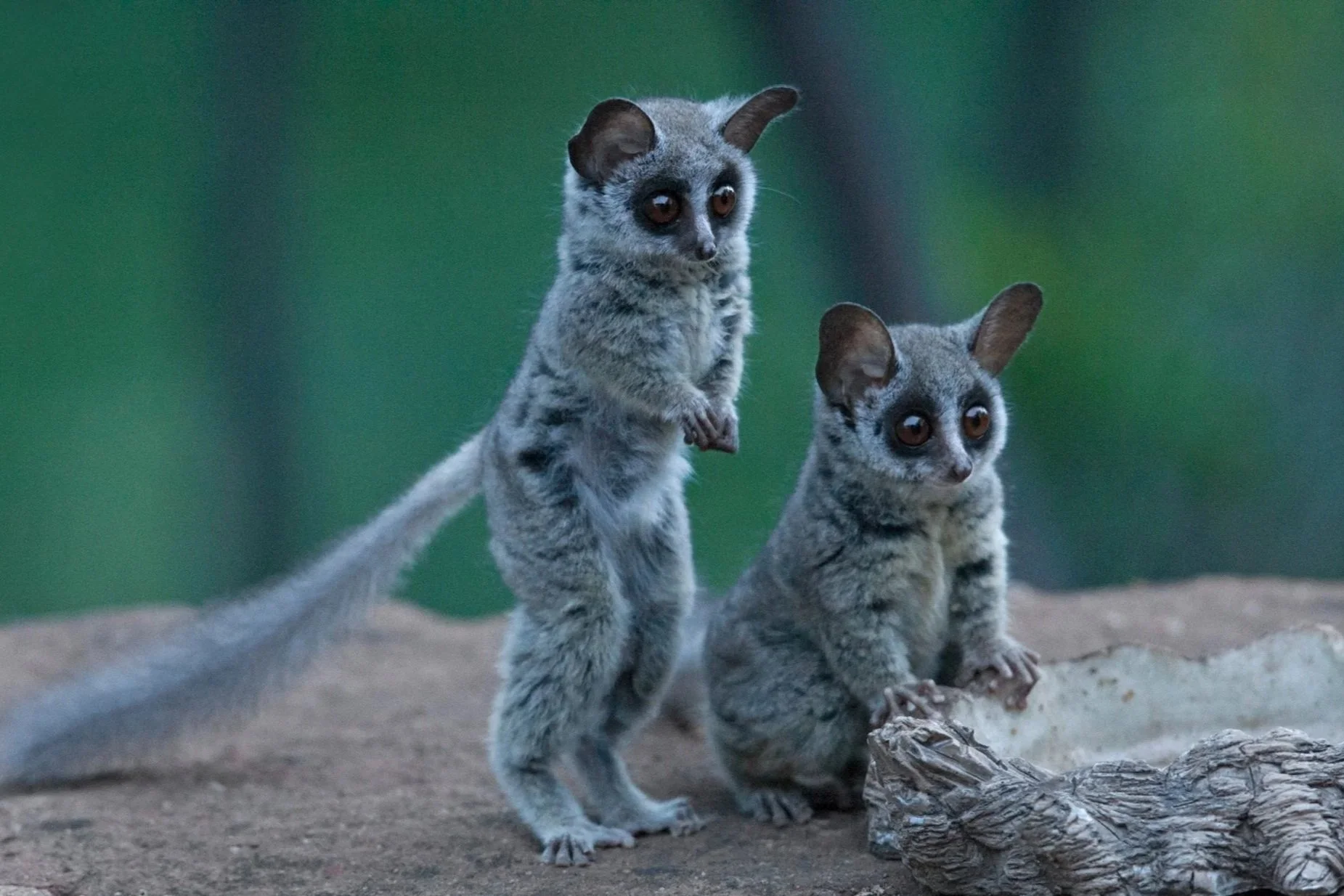
Credit to Dean
Bushbabies, or galagos, are small, enchanting nocturnal primates belonging to the family Galagidae. They are one of the most distinctive creatures you might encounter on a night walk.
Species Found in Uganda
Uganda hosts several bushbaby species. The most commonly encountered include the lesser bushbaby and the thick-tailed bushbaby. The eastern needle-clawed bushbaby (Galago inustus) and Demidov's dwarf galago (Galagoides demidovii) have also been recorded.
Key Characteristics and Behaviour
Size: Most bushbabies are roughly the size of a squirrel.
Eyes: Huge, luminous, forward-facing eyes that provide exceptional night vision and depth perception.
Ears: Collapsible ears that rotate independently, allowing them to pinpoint insect prey in complete darkness.
Tail: A long, bushy tail used for balance while leaping between branches.
Vocalisation: Their piercing cry sounds like a wailing human baby, which is exactly how they earned the name "bush baby".
Movement: They are extraordinary jumpers, capable of leaping 2–3 metres in a single bound.
Diet: Insects, fruits, and tree gum.
Bushbabies are predominantly solitary, though the thick-tailed bushbaby is known to form small family groups. They spend their days sleeping in hollow tree trunks or dense foliage, emerging at dusk to forage.
Potto (Perodicticus potto)
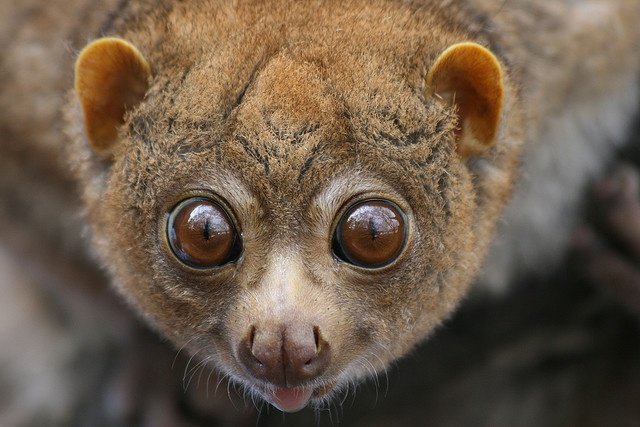
The potto is a slow-moving, almost sloth-like nocturnal primate that inhabits Uganda's forest interiors.
Key Characteristics and Behaviour
Appearance: The potto has a hunched back and a soft, thick coat. It is sometimes called a "bush bear" or "softly softly" due to its gentle, deliberate movements.
Movement: It moves slowly and silently through the trees, feeding on fruit, insects, and tree gum.
Grip: The potto has an incredibly strong grip that allows it to cling to branches firmly, even while hanging upside down for long periods.
Behaviour: Pottos forage upside down from tree branches at night and curl up in tree hollows during the day. Their slow, smooth gait makes them relatively inconspicuous, even when they are nearby.
The potto is a relative of the loris and shares its deliberate, stealthy approach to navigating the forest canopy.
Where to See Nocturnal Primates in Uganda
Kibale National Park – The Primate Capital
Kibale National Park is the premier destination for nocturnal primate viewing in Uganda. Known as the "Primate Capital of the World", it is home to 13 primate species – more than any other East African park.
Kibale's nocturnal primates include pottos, Demidov's dwarf galago, and the eastern needle-clawed bushbaby. The park is also renowned for its chimpanzee trekking, with the largest chimpanzee population in Uganda (over 1,450 individuals).
Night walks in Kibale begin at approximately 7:30 PM and last 1.5 to 2 hours.
Semuliki National Park
Semuliki National Park, located in the Albertine Rift Valley, also offers excellent night walk opportunities. The park is home to bushbabies and pottos, as well as a rich diversity of other nocturnal animals.
Kalinzu Forest Reserve
Kalinzu Forest Reserve protects six diurnal primate species and is also home to nocturnal primates, including the potto and two varieties of galago. Night walks here offer a quieter, less restricted alternative to Kibale.
Bwindi Impenetrable National Park
While famous for mountain gorillas, Bwindi also hosts nocturnal primates. Guided nature walks can be arranged for guests staying in the park's lodge, providing an opportunity to spot bushbabies and pottos.
Budongo Forest
Budongo Forest, part of the Murchison Falls Conservation Area, offers night walks where visitors can encounter nocturnal primates such as pottos and galagos. The forest is also known for its chimpanzee population.
Sector Availability Comparison Table
| Location | Nocturnal Primate Species | Night Walk Availability |
|---|---|---|
| Kibale National Park | Potto, Demidov's dwarf galago, Eastern needle-clawed bushbaby | Yes – Best option |
| Semuliki National Park | Bushbaby, potto | Yes |
| Kalinzu Forest Reserve | Potto, two galago varieties | Yes |
| Bwindi Impenetrable National Park | Bushbaby, potto | Limited (lodge-dependent) |
| Budongo Forest | Potto, galago | Yes |
What to Expect on a Night Walk
Timing and Duration
Night walks in Kibale National Park typically begin around 7:30 PM after nightfall. The experience lasts between 1.5 and 2 hours. Your guide will provide a briefing at the Uganda Wildlife Authority headquarters before departure.
Safety and Equipment
Walking through the forest in darkness is a safe, professionally guided activity. The Uganda Wildlife Authority (UWA) provides trained ranger guides who are experts in spotting and interpreting nocturnal wildlife.
Essential equipment:
A powerful torch or flashlight – your guide will have one, but a personal torch is recommended.
Sturdy hiking boots – trails can be muddy, especially after rain.
Long sleeves and long trousers – to protect against insect bites and thorns
Insect repellent – mosquitoes are active at night
A camera with low-light capabilities, but be prepared; flash photography is not recommended.
Safety tips:
Stay close to your guide at all times.
Walk quietly. The experience is more rewarding when animals are not startled.
Let your eyes adjust to the darkness between torchlight sweeps.
Listen as much as you look because the forest is full of sound clues.
💡 Expert Tip: On a night walk, the soundscape is as important as the sightings. You will hear chirping crickets, hooting owls, and the rustle of mammals in the undergrowth. Let your guide interpret these sounds. They can identify species you haven't even seen yet.
What Else You Might See
Night walks are not just about primates. The forest after dark teems with life:
Tree hyrax: These small mammals produce an eerie, shrieking call that echoes through the forest.
Civets and genets: Cat-like nocturnal mammals that hunt for small prey
Serval cats: Small wild cats that hunt in the undergrowth
Night birds: Owls, nightjars, and frogmouths
Reptiles and amphibians: Tree frogs, chameleons, and snakes
Giant forest hogs: Large nocturnal pigs that may be glimpsed crossing trails
Best Time for Night Walks
Night walks are available year-round, but the dry seasons offer the best conditions:
Peak conditions: June–September and December–February (dry seasons)
Rainy seasons: March–May and October–November – trails are muddier, but higher humidity tends to bring out more amphibians and insects, which can be equally rewarding.
Night walks in Kibale are moderately popular and should be booked in advance, either directly through the Uganda Wildlife Authority or through a registered tour operator. Early booking is particularly recommended during the dry season months.
Conservation Importance of Nocturnal Primate Viewing
Night walks contribute to conservation in several ways:
Financial support. The fees paid for night walks go towards the Uganda Wildlife Authority's conservation programmes, funding park management, anti-poaching patrols, and community development.
Awareness. Night walks introduce visitors to species that are often overlooked – pottoos, civets, and night birds. This appreciation helps build support for the protection of all forest species, not just the charismatic megafauna.
Research opportunities. Night walks also facilitate research. For example, researchers at Kibale's Ngogo project have documented nocturnal behaviour in chimpanzees, revealing surprising adaptations. Citizen observations from night walks contribute to this growing body of knowledge.
Conclusion
Uganda's nocturnal primates. The charming bushbabies and the mysterious potto offer a glimpse into a hidden world. A night walk in Kibale National Park is more than just wildlife viewing; it is a sensory immersion into the forest after dark, where every sound has meaning, and every shadow might hide a creature.
For travellers seeking to go beyond the standard safari, a night walk is an unforgettable addition to any Uganda itinerary.
Ready to explore Uganda's nocturnal side? At Kwezi Adventures, we can arrange a private night walk with expert UWA guides, ensuring you experience the forest at its most mysterious and captivating.
Enquire About Your Night Walk Experience
People Also Ask
What nocturnal primates live in Uganda?
Uganda is home to several nocturnal primate species, including bushbabies (galagos) and the potto. Bushbaby species include the lesser bushbaby, thick-tailed bushbaby, Demidov's dwarf galago, and eastern needle-clawed bushbaby. The potto is a slow-moving, sloth-like primate.
Where can I see bushbabies in Uganda?
The best place to see bushbabies is Kibale National Park, known as the Primate Capital of the World. Night walks in Kibale offer excellent chances to spot bushbabies and pottos. Other options include Semuliki National Park, Kalinzu Forest Reserve, and Budongo Forest.
What is a potto?
The potto is a slow-moving, nocturnal primate found in Uganda's forests. It is related to the loris, has a hunched back and soft coat, and moves deliberately through the trees at night. Pottos forage upside down from branches and sleep in tree hollows during the day.
What time do night walks start in Kibale Forest?
Night walks in Kibale National Park typically begin around 7:30 PM after nightfall. The walk lasts 1.5 to 2 hours and is guided by an armed Uganda Wildlife Authority ranger guide. A briefing is provided before departure.
How long is a Kibale night walk?
A typical night walk in Kibale Forest National Park lasts between 1.5 and 2 hours. The walk follows designated forest trails, with your guide using a torch to spot wildlife in the darkness.
Do I need a permit for a night walk in Kibale?
Yes, you need to book and pay for a night walk through the Uganda Wildlife Authority (UWA) or a registered tour operator. Night walks are moderately popular and should be booked in advance, particularly during the dry season (June–September, December–February).
Are night walks in Kibale safe?
Yes, night walks are safe when conducted with a trained UWA ranger guide. The guide is armed and experienced in identifying and responding to wildlife. Visitors are advised to stay close to the guide, follow instructions, and avoid making sudden movements or loud noises.
What other animals can I see on a Kibale night walk?
Apart from bushbabies and pottos, you may encounter tree hyraxes, civets, genets, serval cats, giant forest hogs, night birds (owls, nightjars, and frogmouths), reptiles like chameleons and tree frogs, and various insects. The forest soundscape is as memorable as the sightings.
How many primate species are in Kibale National Park?
Kibale National Park is home to 13 primate species – more than any other East African park. This includes chimpanzees, red colobus, black and white colobus, L'Hoest's monkeys, red-tailed monkeys, blue monkeys, baboons, and grey-cheeked mangabeys, as well as nocturnal species like pottos and bushbabies.
Why are bushbabies called bushbabies?
Bushbabies are named for their piercing, wailing cry that sounds remarkably like a human baby's cry. These vocalisations are used by bushbabies to communicate with each other in the dark forest. Each bushbaby has a distinctive cry that differentiates it from others.
