

EXECUTION STANDARDS
How journeys are designed. Where execution matters.
We do not position sustainability or quality as a feature. They are the result of rigid execution rules applied before any itinerary is presented.
Each decision is controlled before the itinerary is presented.

PROPERTY SELECTION
Rule: A property must pass all three criteria below. Fail anyone → excluded.
1. Infrastructure
Solar or hybrid power systems
Controlled water sourcing or on-site purification
2. Operational Footprint
Waste handling systems
Supply chain sourcing >60% local (by spend) – verified
3. Environment Control
Max guest density ≤12 rooms or ≤24 guests per night
No mass‑tourism checklists (e.g., group programs >8 pax)
What we do not include:
Properties with diesel‑only power
No water management plan
Any lodge that fails a single variable – no second review
ROUTING EFFICIENCY
We do not “suggest” efficient routing. We enforce it.
Fixed constraints (applied to every itinerary):
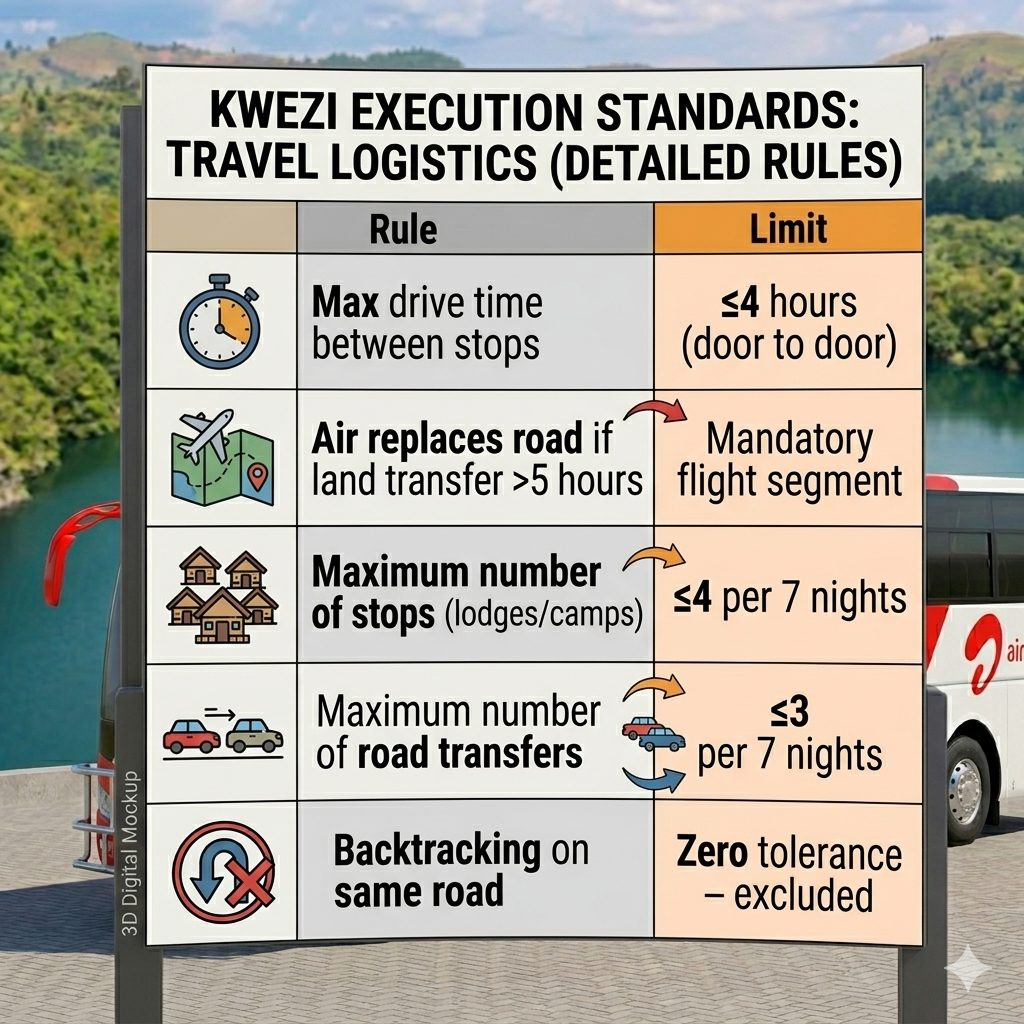
What we do not include:
Any itinerary with >4 hours driving per transfer
Repeated roads in the same direction
More than 4 stops in 7 nights
Commercial value to you:
Time saved = more wildlife viewing, less fatigue. Friction removed = higher perceived journey value.

STAY STRUCTURE
Presence over movement is mandatory, not a suggestion.
Standard design rules (enforced):
Minimum 2 nights per region – no exceptions
No single‑night remote stops – excluded entirely
Minimum 3 nights in high‑value locations (e.g., gorilla sector, tree‑climbing lions)
What this eliminates:
Fatigue from repacking
Lost half‑days to check‑in/check‑out cycles
Discontinuous experience flow
What we do not include:
Any itinerary with a 1‑night stay in a remote area
Consecutive single‑night moves
Commercial value to you:
Continuity = deeper immersion. You pay for presence, not transfers.
COMMUNITY REVENUE FLOW
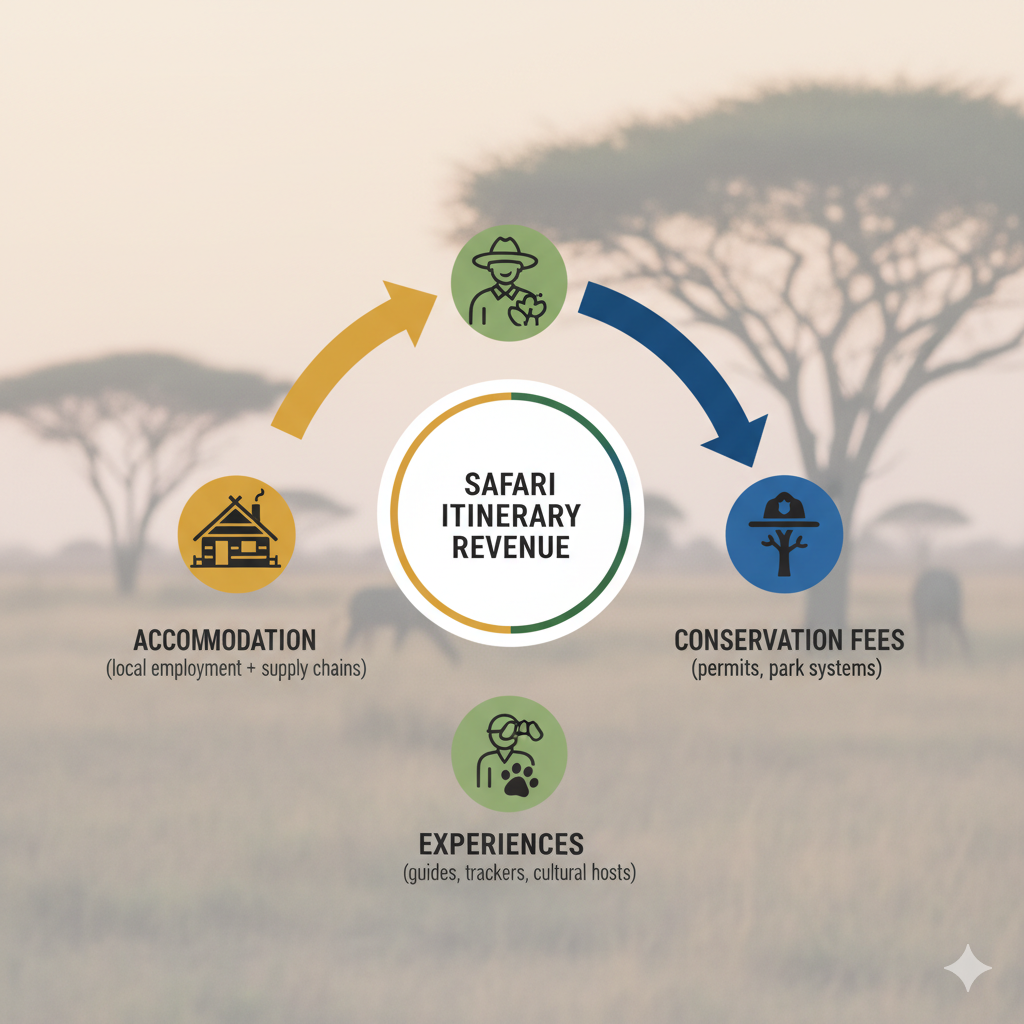
We do not say “we support communities.” We show exactly how money moves.
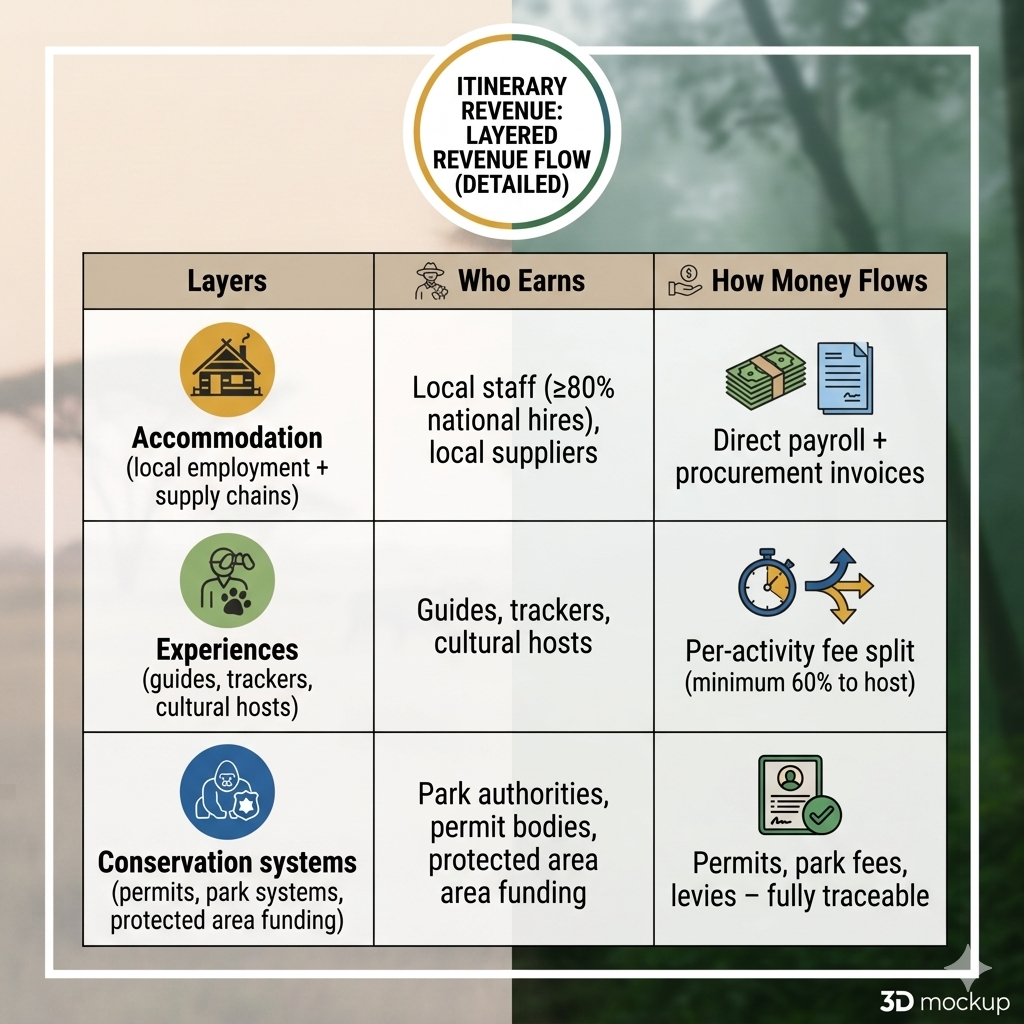
Every stop has a defined economic function across three layers:
What we do not include:
Any lodge unable to show the local payroll share
Experiences where <60% of the fee goes to the local host/guide
“Community visit” as a passive add‑on without a defined revenue flow
Commercial value to you:
You see exactly where value is created. No greenwashing. Every dollar is accountable.
EXPERIENCE CONTROL
Access is managed by limits, not assumed by a brochure.
We enforce:
Controlled guest environments – max group size 6 for wildlife, 8 for cultural visits
Verified conservation‑linked properties – membership in recognised program (e.g., Eco‑Tourism Kenya, Global Sustainable Tourism Council – certified)
Experiences with daily capacity caps – we check actual caps (e.g., gorilla permits: 8 per group, no overrides)
What we do not include:
Open‑access sites without guest limits
Any experience that cannot confirm daily capacity control in writing
Overcrowded environments (more than 4 vehicles at a sighting)
Commercial value to you:
You avoid degraded environments and inconsistent delivery. What is promised is what you get.

ITINERARY INTEGRATION
Execution standards are not a separate document. They are the built logic.
This is how an itinerary is constructed, step by step:
Property pass/fail (from Property Selection) → creates allowed lodge list
Routing constraints (max 4h drive, no backtracking) → defines possible sequences
Stay structure rules (min 2 nights per region, no single‑night remote) → sets night distribution
Community revenue check → each stop must show all three layers
Experience capacity verification → only if daily cap confirmed
If any step fails → the itinerary is rejected at the design stage.
What we do not include:
Standard volume‑optimised itineraries (more stops, more driving)
Any journey that violates even one rule above
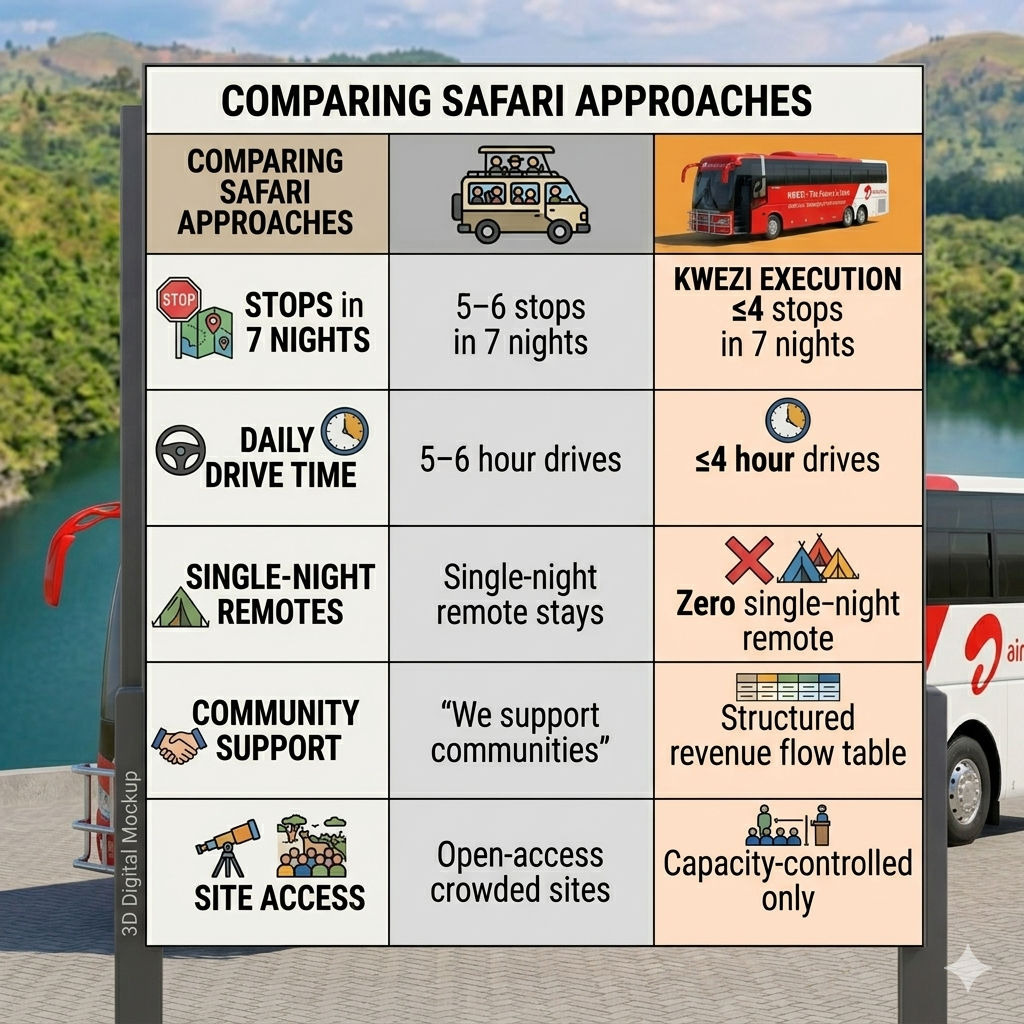
Before vs. after contrast:
WHY THIS MATTERS
This is not about being “eco‑friendly” or “thoughtful.”
It is about removing measurable friction:
Time saved – Up to 30% less driving vs. standard safaris
Fewer logistical disruptions – No backtracking, no single‑night repacking
Controlled environments – No overcrowding, consistent delivery
Higher effective value – You pay for presence, not transfers
Why does this cost more?
Because we reject 70%+ of properties, routes, and stops that others include.
Constraints create scarcity. Scarcity protects quality. Quality justifies price.
Trust = high. Authority = dominant. Differentiation = clear.
This is where value is created – not in added activities, but in how the journey is controlled from start to finish.

Fewer properties. Better routing. Higher control.
This is where value is created.
Not in the added activities.
But in how the journey is constructed.